
Frequently asked questions
Below are all our commonly asked questions. If your question is not answered below, please contact us.
Below are all our commonly asked questions. If your question is not answered below, please contact us.
This e-guide explains the rates at which Value Added Tax (VAT) and Climate Change Levy (CCL) are chargeable on electricity and gas supplies.
In line with current legislation (VAT Act 1994 as amended), there are two rates of VAT applicable to supplies of electricity and gas used for business or non-domestic purposes:
Where an electricity or gas supply is used wholly or partly for domestic or charitable non-business use, that part of the supply qualifies for the reduced rate of VAT. This is known as
'qualifying use'.
Customers with qualifying use are required to submit a separate Customer Declaration Certificate for each supply, to advise us what percentage is used for domestic or charitable on-business purposes.
CCL is a government-imposed tax to encourage reduction in gas emissions and greater efficiency of energy used for business or non-domestic purposes.
CCL is chargeable only on units/kWh used and not on any other component of the bill such as fixed daily charges.
Separate rates have been set for electricity and gas. These are now indexed-linked and therefore likely to increase on 1 April each year.
Under current legislation:
All other business customers entitled to CCL relief must submit a PP11
Supplier Certificate for each supply covered, to advise us what percentage of CCL relief is applicable. PP11s can be downloaded from the HM Revenue & Customs (HMRC) website: www.hmrc.gov.uk.
If your electricity or gas supply is used solely for business or non-domestic purposes, VAT will usually be charged at the standard rate and CCL (plus VAT on CCL) will also be added to the bill
Low usage business or non-domestic use
Under a government concession, 'low usage' of electricity and gas for business or non-domestic purposes is chargeable at the reduced rate of VAT. These supplies are automatically excluded from CCL.
The low usage thresholds are:
Where more than one meter is billed on an account, consumption across all meters is combined in order to take into account the total quantity supplied through all relevant meters.
There is no requirement for the customer to claim the reduced rate of VAT or exclusion from CCL on low usage as these concessions are applied automatically at the time of each billing.
If your electricity or gas supply is used wholly or partly for domestic or charitable non-business purposes, that part of the supply qualifies for the reduced rate of VAT and for exclusion from CCL. This is known as qualifying use.
The percentage of qualifying use can vary between energy supplies to the same site. Customers are therefore required to submit a separate Customer Declaration Certificate per fuel, per account, to advise us what percentage of each supply meets the qualifying criteria (set by the government).
See pages 4 and 5 for further details regarding which activities do and do not meet the government's qualifying criteria to be considered as domestic or charitable non-business use.
We cannot assume a percentage of qualifying use on behalf of the customer. In the absence of a valid Customer Declaration Certificate, supplies will be charged VAT and CCL at the rates appropriate to business or non-domestic use. Where there is both qualifying and non-qualifying use of the supply, this is known as 'mixed use'. Please refer to the mixed use section on page 6 for further details.
What types of supply are considered to be domestic use?
More detailed infomation can be obtained from HMRC: www.hmrc.gov.uk
HMRC National Advice Centre: 0845 0100 9000
See the following HMRC VAT notices available from their website:
101/19 - Fuel and power
701/20 - Caravans and Houseboats
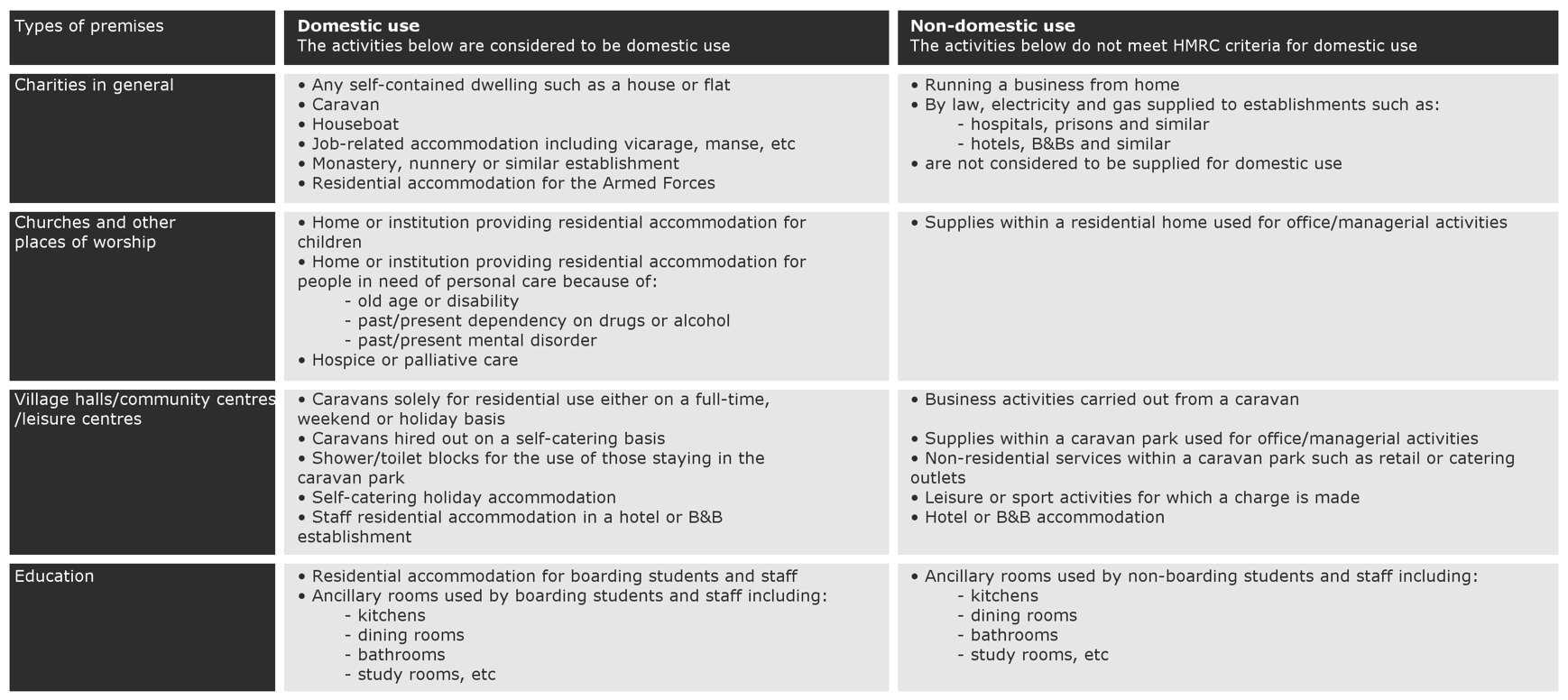
Although you must either be a registered charity or have your charitable status recognised by HMRC, that in itself is not deemed to be an automatic qualifying use. There is no general VAT relief for charities on electricity and gas supplies. However, legislation does provide specific relief for the nonbusiness activities of a charity, whereby that part of the supply is seen as a qualifying use. If you are a registered charity and the supply is used for domestic purposes, your declaration should be on the basis of domestic use. See page 4.
HMRC: www.hmrc.gov.uk
HMRC National Advice Centre: 0845 0100 9000.
See the following HMRC VAT notices available from their website:
701/1 - Charities
701/5 - Clubs and Associations
701/30 - Education
701/35 - Youth Clubs
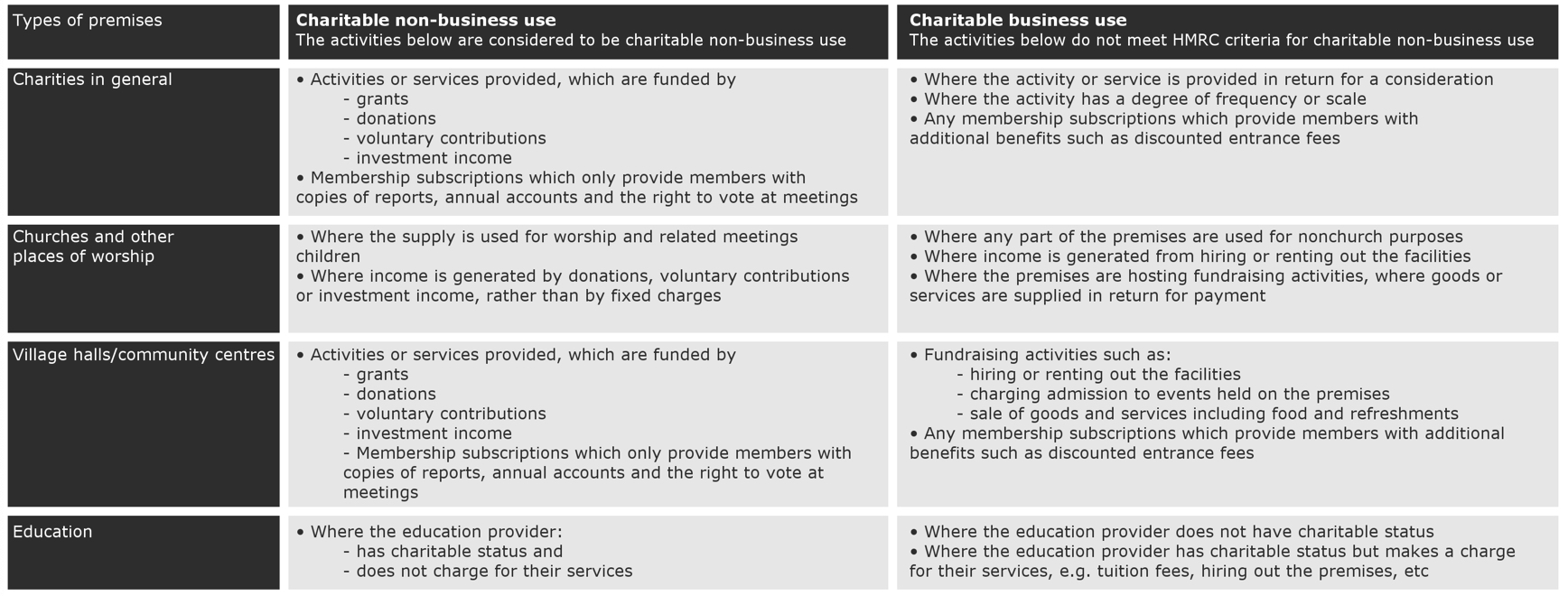
Where there is a mix of activities, some of which meet the government's criteria for domestic or charitable non-business use and some which do not, you will need to estimate the split between qualifying and non-qualifying use, for each individual meter, in order to submit the appropriate VAT declaration. Your estimate can be based on any method that is 'fair and reasonable', such as rating of appliances, annual consumption or square footage. Charities can use their annual accounts to estimate the split between 'non-business' funding and 'business' income.
In all cases, you must be able to demonstrate to HMRC (if required), that any VAT declaration you submit, represents a valid qualifying use.
Currently:
Declaration forms:
Customers with qualifying use are required to submit a separate Customer Declaration Certificate for each supply, to advise us what percentage is used for domestic or charitable nonbusiness purposes.
Important information
VAT Customer Declaration Certificates and PP11 Supplier Certificates are not transferable between suppliers. When changing suppliers, you should ensure that the appropriate certificates are submitted to your new supplier, advising the percentage of relief which is applicable to each supply. Once accepted, your declaration will remain valid indefinitely. If there is a change in your qualifying use, you should notify us by submitting a revised Customer Declaration Certificate. Any false statement or failure to notify us of a change in qualifying use may make you liable to a financial penalty under the VAT Act 1994 (as amended from time to time).
When someone deliberately interferes with a gas or electric meter, so their energy usage isn’t recorded properly, or stops being recorded altogether.
The illegal abstraction of electricity/gas or the deliberate interference (or tampering) with a meter to prevent it from accurately recording consumption are criminal offenses under the Theft Act 1968 and the Gas Act 1986 respectively.
Energy theft is not only costly to the public, but incredibly dangerous.
Tampering with a gas meter can lead to gas leaks, causing respiratory problems, unconsciousness, and many other health issues. Natural gas is extremely flammable and if it is leaking, flicking a light switch is all it takes to cause an explosion risking terrible injuries.
Electric meters that have been tampered with can overheat, malfunction, and become ‘live’. This can cause electrocution and other serious illnesses.
In worst case scenarios, tampering with meters could result in potential fatalities.
It can be difficult to tell whether a meter has been tampered with, keep a look out for the following signs.
Suspicious calls or emails from anyone who suggests they can save you money, especially cold callers claiming to be from a reputable company.
If you suspect illegal activity, then report it immediately to us: 0843 504 7799, or account.services@evolve-energy.com
If you would prefer to remain anonymous, you can visit Report Energy Theft – stayenergysafe.co.uk
StayEnergySafe is powered by the Crimestoppers charity. You can contact them anonymously on 0800 023 2777, or through their online form.